Monday, April 18, 2016

Event Blog 1: Hammer Museum

I attended the Leap Before You Look: Black Mountain College 1933-1957 Poetry Reading at the Hammer Museum. I had never heard about Black Mountain College before coming to the event. Overall I had a great time, the Hammer Museum is very beautiful and modern.


http://www.thefamilysavvy.com/2016/03/now-at-the-hammer-leap-before-you-look/


    Four of the college’s literary descendants spoke at this event. The speakers included Rachel Blau DuPlessis, Duncan McNaughton, Michael Davidson, and Michael Palmer. They all seemed very passionate about the institution and the profound impact it had. The first speaker finished with two beautiful poems. All four speakers went on to have great careers in poetry and literature. I felt a little lost when they were referencing old poets and the crowd would laugh, but overall I had a great time. I tried the seat that can’t tip over which was in the outdoor courtyard.   
      
 
     (Courtyard at the Hammer Museum)               (My friends and I with a Hammer employee)

I find the idea of Black Mountain College very fascinating. It was a liberal arts college in North Carolina and it was the first of it’s kind. It was the first college to admit African American Students during times when all other colleges were segregated. It also was an important incubator for the avant garde. This college was very important in the art community because it greatly emphasized the importance of artists in society.


Learning about the artists and Black Mountain College reminded me of our first week involving Two Cultures. By having a school dedicated to solely the arts in a very Science-based world was a huge leap for poets, writers, musicians, etc. The “Leap Before You Look” program carries on the legacy of the college and reminds the public how influential it was for the Art Community. I would definitely recommend anyone to go to this event if they get the chance. It was very interesting to learn about and the Hammer museum is very beautiful and modern. Being surrounded by such successful artists and poets was inspiring and an amazing experience!

Tuesday, April 12, 2016

Week 3: Robotics and Art

Technology emerged from Art, so therefore they go hand in hand. In Professor Vesna’s Lecture, I learned about how mass production, robotics, and computers came about. Robots emerged in relation to mass production and assembly lines. Mass production was first introduced with Gutenberg’s creation of the printing press, and later when Ford had aspirations to make cars accessible to everyone. Mass production happened during a time called “The Second Industrial Revolution.” Books were now able to be printed exponentially faster than before, art work was able to be replicated and distributed, cars were able to be mass produced, etc. This was an amazing innovation, but it also had some downsides. Workers were treated terribly in this time.
(The Printing Press)

(Henry Ford and others in a car, 1907)

A movie that I have seen that takes place during the Industrialization time period is Oliver Twist. In this movie, child labour is displayed through a young boy who worked as a chimney sweeper. This showed how it was to live during a time when things converted from traditional labour to machine-driven, highly productive labour caused by Industrialization.

Oliver Twist (1948)

With mass production and mechanization, art can lose its authenticity, as Benjamin Walter said in “The Work of Art in the Age of Mechanical Reproduction.” Benjamin Walter’s has been said to have been affiliated with “Western Marxism.” He wrote that “Even the most perfect reproduction of a work of art is lacking in one element: it’s presence in time and space, its unique existence at the place where it happens to be” (1). I agree with this statement, because the original just has a little something extra than the duplicates. Art has lost it’s “aura” because it can be reproduced.

(Andy Warhol's "Campbell's Soup Can" Mass Produced Artwork)


The technological advancements in this time period created a major social change. Many things were now machine driven as opposed to traditional labour. Computers and other machines sped up the mechanization process. Computers are ultimately the fusion of mass production and robotics. It was difficult for society to adjust to such a drastic change, but ultimately there were positives and negatives that came along with it.


Works Cited

Vesna, Victoria. “Lecture 2.” Cole UC online. Youtube. 15 Apr 2012. Web. 12 Apr 2016.

Robinson, Andrew. “An A to Z of Theory | Walter Benjamin: Art, Aura and Authenticity.” Ceasefire. 14 Jun 2013. Web. 12 Apr 2016.

Davidson, Niel. “Walter Benjamin and the classical Marxist tradition.” Traditional Socialism. 2 Jan 2009. Web. 12 Apr 2016.

Jin, Julia. “Charles Dickens and his work depicting the Industrial Revolution.” Western Civilization II Guides. 28 Apr 2012. Web. 12 Apr 2016.

History.com. “Industrial Revolution.” History.com. A+E Networks. 2009. Web. 12 Apr 2016.

Sunday, April 10, 2016

Week 2: Math and Art

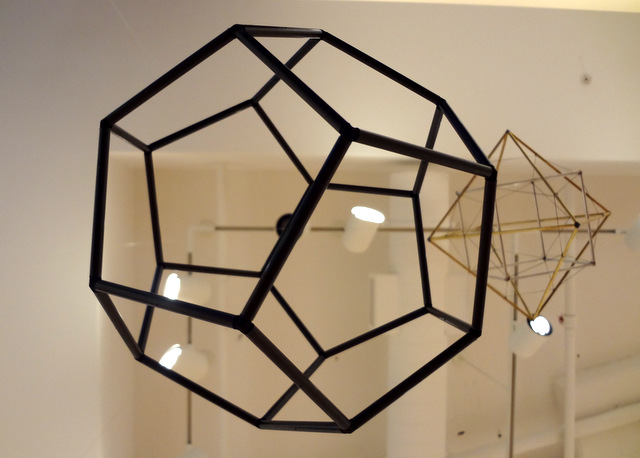
Before this week’s lecture I had never thought about how heavy of an influence mathematics actually has on art. In Renaissance times when new discoveries were being made, artists would use math for the incorporation of shapes into their work. They would need to measure the areas or volumes of shapes like circles, ovals, polygons, and spheres. Another major discovery made was the concept of using formulas in order to change the perspective of paintings. Artists could now draw 3-dimensional drawings on 2 dimensional objects due to the incorporation of math into their work. Math was also incorporated into art when architects were designing buildings. Famous Egyptian and Greek structures were built upon the theories of Artists' mathematic formulas.The historical buildings, paintings, sculptures, and other famous artistic pieces we see today would not be the same if it weren’t for mathematics.


(Contemporary shapes in an Art Gallery)

One of the most revolutionary introductions of mathematics into art was Da Vinci’s Vitruvian man. It has been used as the main symbol of the fusion of math and art. The drawing is based on the ideal of human proportions geometrically described by architect Vitruvius. The human figure is a source of proportion in regards to classic architecture. Each small part of the human body is a fraction of the whole. Da Vinci tried to connect this idea of human proportion as the ideal to other aspects of the natural world. He even stated that “Man is the model of the world.” This diagram was studied and used by countless Artists and Architects throughout history. 


I found it very fascinating learning about how math was such a critical part of art.
The idea of creating impressions of depth and 3D images was initially introduced by Giotto, then it was perfected by Brunelleschi. Brunelleschi is credited with the first correct formulation of linear perspective. The science of optics was another widely studied perspective. Al-Haytham introduced his book which gave the first correct explanation of vision. Alberti and Piero de la Francesca both used Al-Haytham’s study in their own work. Then, Leonardo Da Vinci began to write about perspective, and developed mathematical formulas regarding distance of object to the eye. One concept that I find the most interesting is the golden ratio, which was the ultimate connection of art and science. It was first shown in the Great Pyramids of Egypt. The ratio was also used in other famous historical structures, like the Parthenon in Greece.
I would explain the juxtaposition of art and science as two things that go hand in hand, as mathematic tools are essential to creating art as we know it. Paintings can appear to be 3 dimensional because of mathematic formulas and architectural structures are both functional and appealing to the eye because of concepts like the “Golden Ratio.” Art would not be the same today if it weren’t for the theories of Renaissance Artists and Mathematicians.

Works Cited

“Vitruvian Man.” BBC. BBC. N.d. Web. 8 Apr 2016.

Vesna, Victoria. “Lecture 2.” Cole UC online. Youtube. 9 Apr 2012. Web. 8 Apr 2016.

History.com Staff. “Leonardo Da Vinci.” History.com. A+E Networks. 2009. Web. 9 Apr 2016.

“Discovering Linear Perspective.” The Renaissance Connection. Allen Town Art Museum. N.d. Web. 9 Apr 2016.

“Brunelleschi’s Peepshow and the Origins of Perspective.” Dartmouth.edu. Paul Calter. N.d. Web. 9 Apr 2016.